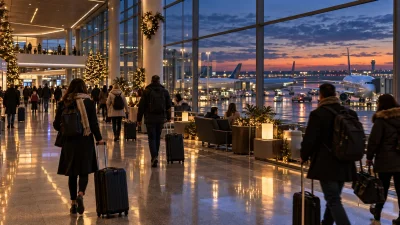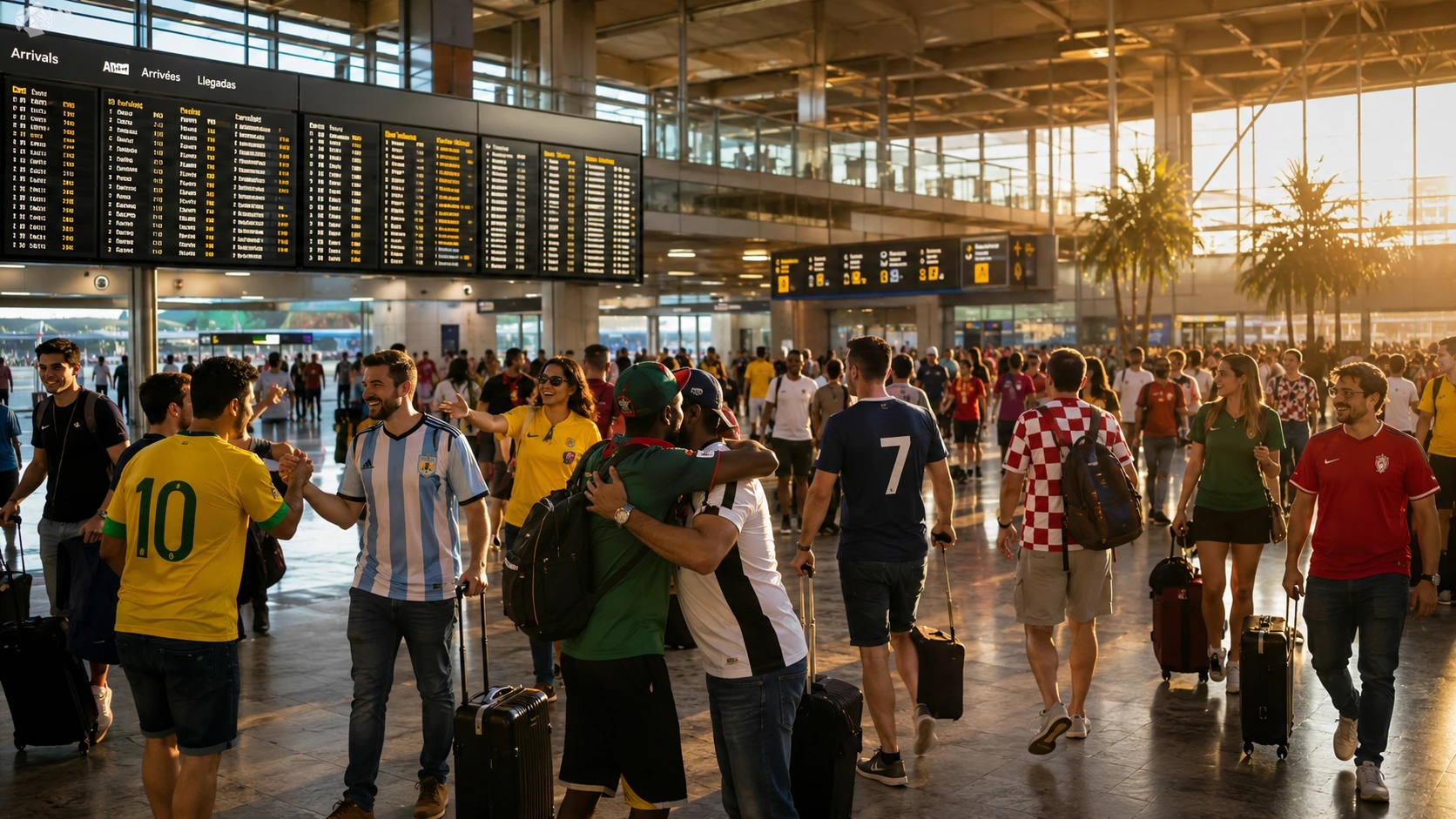
Somewhere over the Atlantic right now, a national team is flying to a training base most Americans have never heard of. Somewhere over Texas, a Southwest 737 is quietly ferrying a squad between two host cities on a same-day turn. And somewhere in a terminal in Houston or Miami or Toronto, a family that flew in from three continents is standing in a security line that did not exist eighteen months ago. This is what the largest FIFA World Cup in history looks like from 35,000 feet, and it is not a metaphor to say American aviation has never been asked to do anything quite like it.
The 2026 World Cup kicked off June 11 and runs through July 19, with 48 teams and 104 matches spread across 16 host cities in the United States, Canada, and Mexico. The final lands in the New York and New Jersey area. Forecasters are putting the total inbound tourism figure as high as 10 million visitors to the United States alone, a number that would be remarkable in a normal year and is almost reckless in a summer when the industry is already running near capacity. This is not a story about soccer. It is a story about whether a travel infrastructure built for steady, predictable demand can absorb a shock this size without cracking.
The Numbers Behind the Surge
Individual host city airports are publishing figures that would have sounded like exaggerations a year ago. Toronto Pearson is bracing for 17 million passengers this summer. Vancouver International expects 2.7 million during the tournament window alone and has installed CT scanners and a dedicated FIFA coordination desk running around the clock. Miami is planning for 1.2 million additional passengers. Philadelphia is projecting nearly 9.4 million summer travelers, up more than 6 percent year over year. Houston's two major airports are handling more than 4.5 million passengers tied directly to the tournament, a burden made heavier by the fact that Houston is one of the only host cities with nonstop connections to every other venue.
The airport congestion is not evenly distributed. It clusters violently around match days, when a single fixture can pull tens of thousands of fans into one metro area within a 48-hour window. Airlines and airport operators are openly telling travelers without tickets to simply stay away from host cities on those days, a rare and telling piece of public advice from an industry that usually wants every seat filled.
Team Charters Add a Second, Invisible Layer
Beneath the commercial chaos sits a parallel team charter flights operation almost no fan sees. Thirty nine of the tournament's official team base camps are located in the United States, and each squad is running repeated round trip charter flights between its camp and whichever city hosts its next match, rather than relocating outright. Germany is based in Winston Salem. Saudi Arabia is working out of Austin. Qatar has anchored in Santa Barbara. American Airlines, working alongside FIFA's official partner Qatar Airways, is absorbing much of the international movement, while Southwest Airlines has been quietly running short hop 737 MAX flights to shuttle squads between smaller base camp airports and the major hubs, including a same day leg moving the Czech Republic from Newark to Dallas Love Field.
That is an extraordinary amount of specialized scheduling to layer on top of an already strained system, and it is happening at exactly the moment U.S. carriers have less spare capacity than usual. The collapse of Spirit Airlines earlier this year pulled a significant chunk of low-cost seat inventory out of the domestic market right before the busiest tourism event North America has ever hosted. Fewer discount seats means fans are competing harder for the ones that remain, and it means legacy carriers are absorbing demand that would once have gone to a budget alternative.
What Airports Are Actually Doing About It
To the industry's credit, this has not been a passive summer. The rollout of eGates has accelerated sharply, and a joint federal task force has been working to smooth communication between border agencies so international arrivals process faster. Touchless ID and expanded biometric boarding are now standard at several of the busiest host city terminals, and the FAA has layered in temporary flight restrictions and no drone zones around every stadium, along with special ground delay procedures for private and charter aircraft operating in host city airspace during peak windows.
Some of this technology was already on the roadmap before FIFA ever chose its hosts. What the tournament did was compress a five year rollout into eighteen months, which is its own kind of lesson. The industry can move fast when a hard deadline forces it to. The open question, once the last ball is kicked on July 19, is whether any of that urgency survives the tournament or quietly reverts to the old pace the moment the cameras leave.
The Fan's Actual Playbook
For fan travel, the calculus is simple even if the airspace above them is not. Book earlier than instinct suggests, because demand curves on World Cup routes do not behave like normal summer travel. Build in significantly more time at the airport, particularly on match days, when security and immigration lines can run far longer than posted estimates. If a trip does not involve an actual ticket to a match, seriously reconsider flying into a host city center on the day of a fixture, since the advice from airport operators to stay away is not exaggeration, it is triage. And travelers heading to venues that also see heavy team charter traffic, including the hubs profiled in our breakdown of the best U.S. airports for the sports traveler, should expect ground transportation and curbside pickup to be the actual bottleneck, not the flight itself.
There is a version of this summer where American aviation quietly proves it can handle the world's largest live sporting event without the visible meltdowns that have defined recent holiday travel weekends. There is another version where a single major weather delay collides with a marquee match day and the whole system backs up for 72 hours. Both outcomes are still on the table with more than two weeks of tournament left, and either way, the data this summer generates will shape how U.S. airports plan for the next mega event, whichever one comes next.