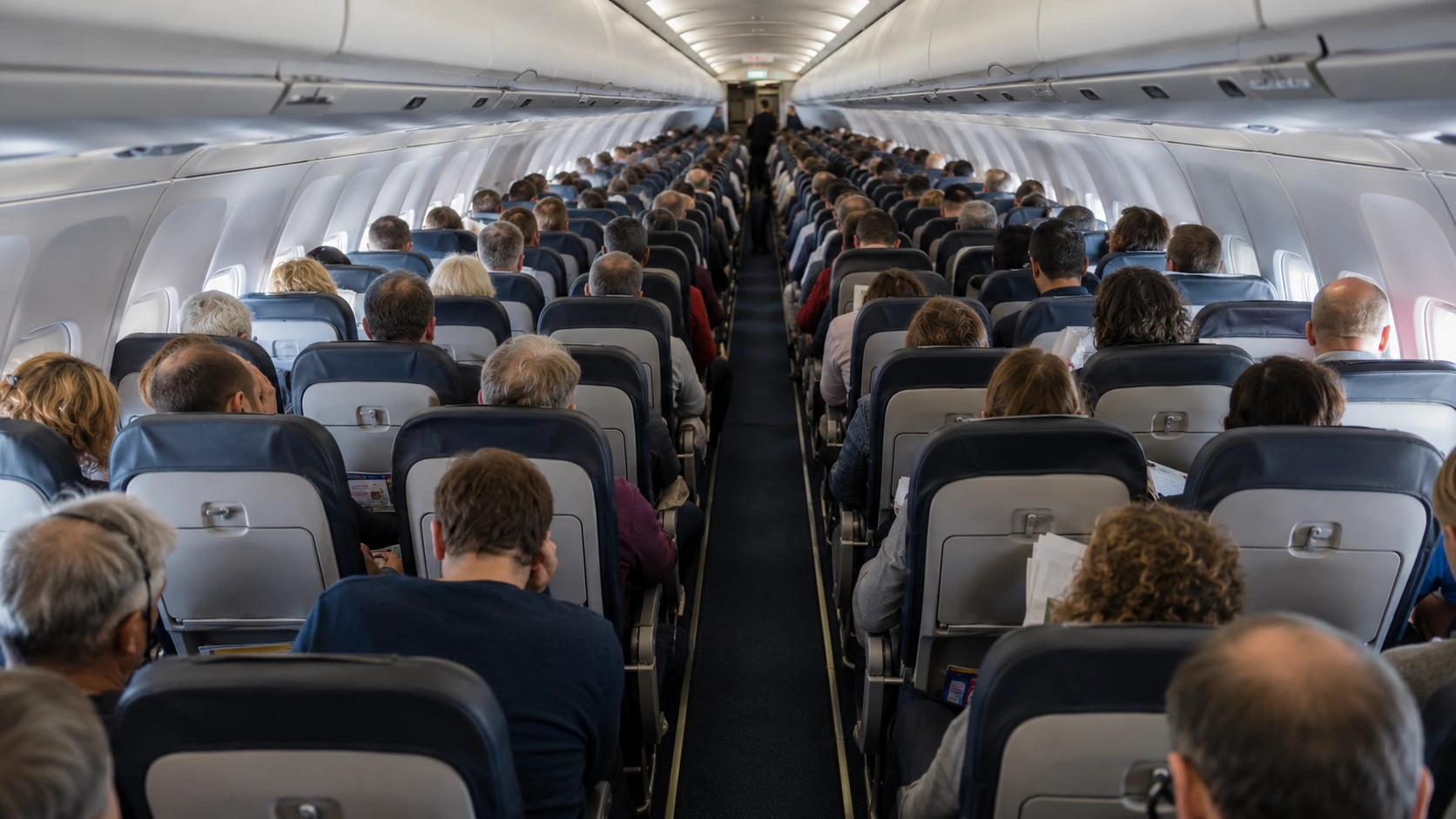
There is a number most airlines would prefer you never look up before you book. It is not the bag fee. It is not the change fee. It is the seat pitch, that single measurement in inches that tells you exactly how much space exists between your knees and the seatback in front of you. For decades, that number has been quietly shrinking, and in 2026, the gap between the most generous and most cramped carriers in the United States has grown wider than at any point in modern commercial aviation history. If you have gotten on a flight lately and thought the cabin felt tighter than you remembered, you were not imagining it.
Here is what the airlines are not advertising, what Washington has mostly failed to fix, and what you can actually do about it the next time you book a ticket.
The seat pitch squeeze did not happen overnight. Before airline deregulation in the late 1970s, the standard economy row measured around 35 inches of pitch. By the 1990s, that number had fallen to roughly 32 inches. Today, the average across major U.S. carriers sits at around 30 to 31 inches, and the most aggressive cabin densification programs have pushed some configurations to just 28 inches. On seat width, the decline has been equally measurable: the industry standard in the 1980s was approximately 18 to 19 inches. Today, many domestic economy seats measure 16.5 to 17.3 inches, with some regional aircraft configurations going narrower still.
Research comparing major U.S. carriers found that across American, Delta, United, and Southwest, seat pitch has been reduced by between two and five inches over the past several decades, while seat width has decreased by around two inches. Compounding the physical reality, the average American adult weighs roughly 15 pounds more today than they did 30 years ago, according to the U.S. Centers for Disease Control and Prevention. The seats got smaller at the same time the passengers got larger. The result is what anyone who has flown a domestic coach cabin recently already knows viscerally.
On-Time or On-Notice: Which U.S. Airlines Are Actually Performing and Which Ones Are Falling
The business logic from the airline side is straightforward. Adding a single row of seats to a Boeing 737 by reducing pitch from 31 to 29 inches generates approximately six to eight additional seats per flight. Multiply that by thousands of departures per day and the revenue arithmetic becomes compelling enough that almost every major carrier has done it at some point, particularly during and after the financial pressures of the pandemic years.
The 2026 Seat Pitch Breakdown: Carrier by Carrier
Not every airline has approached cabin densification the same way. The spread between the most and least generous carriers in the U.S. now exceeds four inches, a difference that is far more noticeable in an actual seat than it sounds on paper. Here is where each major carrier stands based on current fleet data and published seat maps.
| Airline | Avg. Seat Pitch | Avg. Seat Width | Comfort Tier |
|---|---|---|---|
| JetBlue | 32.3 in | 17.8 – 18.4 in | Best in Class |
| Southwest | 31.8 in* | 17.0 – 17.8 in | Strong |
| Delta | 31.0 in | 17.0 – 17.3 in | Mid-Tier |
| Alaska | 31.0 in | 17.0 – 18.2 in | Mid-Tier |
| American | 30.0 – 30.3 in | 16.5 – 17.0 in | Below Average |
| United | 30.0 in | 16.5 – 17.0 in | Below Average |
| Frontier | 28.0 in | 16.0 in | Tightest |
*Southwest reduced its standard seat pitch from 32 to 31 inches in early 2026 as part of its transition to assigned seating. Exit rows still offer up to 39 inches. Sources: Simple Flying, Upgraded Points, Business Traveller, SmarterTravel fleet data 2025-2026.
JetBlue leads the domestic market by a meaningful margin, averaging 32.3 inches of seat pitch across its Airbus A320 and A321 fleet, with some configurations reaching 34 inches. The airline flies narrowbody aircraft exclusively and configures them with fewer rows than competitors, a deliberate product choice that sacrifices seat count in exchange for a differentiated passenger experience. Southwest, despite its recent reduction, still ranks second nationally at 31.8 inches. Delta and Alaska sit tied at 31 inches, a solid mid-tier position. American and United both clock in around 30 inches on most domestic narrowbody routes, and Frontier now operates at the tightest end of the major-carrier spectrum at 28 inches.
On seat width, the hierarchy is similar. JetBlue's wider fuselage aircraft give its seats a natural advantage. Alaska offers some of the widest regional jet seating at around 18.2 inches on its Embraer fleet. The three legacy giants, American, Delta, and United, generally do not stand out for seat width on their mainline domestic operations, hovering between 16.5 and 17.3 inches depending on aircraft type.
The political history of airline seat regulations in the United States is a case study in good intentions running headlong into industry lobbying. The story starts with the Seat Egress in Air Travel Act, known as the SEAT Act, a bipartisan bill introduced in both the House and Senate that would have directed the FAA to establish minimum dimensions for passenger seat comfort, including minimum pitch, width, and length, as well as guaranteed adequate space for emergency evacuation.
Key provisions of the SEAT Act were stripped out before the bill reached the floor. Congress eventually mandated in the FAA Reauthorization Act of 2018 that the agency at least study the safety implications of current seat dimensions and report back. The FAA completed evacuation testing in 2022 using 720 live participants. Consumer advocates immediately criticized the study for its demographic gaps: it excluded passengers under 18, over 60, overweight individuals, and those with disabilities, meaning the study population did not reflect the actual flying public. Congressional members pushed back, noting that the FAA could theoretically use the flawed study to set minimum pitch requirements as low as 27 or 28 inches, potentially making the situation worse rather than better.
As of 2026, the FAA has not issued final minimum seat dimension regulations. The agency's position is that current seat pitch levels do not compromise emergency evacuation. Flight attendant unions, passenger rights groups like FlyersRights.org, and multiple members of Congress have consistently challenged that conclusion. "The safety and health of passengers must come before airline profits," said Congressman Steve Cohen, the SEAT Act's lead sponsor, in congressional testimony. The regulation debate is ongoing, with no binding minimum standards expected in the near term.
There is a layer of the cabin space problem that the pitch-and-width data does not fully capture, and that is the rise of basic economy fares. All three major legacy carriers, American, Delta, and United, now sell basic economy tickets that come with the worst seats in the cabin as a default, typically middle seats toward the rear, without the ability to select or change seat assignments without paying additional fees.
The effect is a kind of double compression. Not only has overall seat pitch declined across the industry, but the cheapest tickets now systematically funnel passengers into the worst available seats within whatever pitch exists. A traveler booking a basic economy fare on American or United in 2026 is likely sitting in a 30-inch-pitch middle seat toward the back of the aircraft, with no ability to move without paying a seat selection fee that can range from $15 to $60 depending on the route and how close to departure you are purchasing it.
Delta introduced basic economy fares in 2012, American and United followed. Since then, all three have progressively tightened the restrictions on what basic economy ticket holders can and cannot do. In the first quarter of 2026, ancillary revenue from seat upgrades, extra-legroom fees, and cabin upsells reached record levels across the major carriers, a figure that tells you everything about how deliberately the cabin has been engineered to monetize discomfort.
One of the more quietly frustrating developments in modern air travel is that many of the seat configurations that would have been considered standard economy a generation ago are now being sold as premium add-ons. Delta Comfort Plus offers 33 to 34 inches of pitch. American's Main Cabin Extra and United's Economy Plus offer similarly expanded rows, typically at 34 to 36 inches. JetBlue's Even More Space product pushes up to 38 inches. These products cost real money, typically an additional $25 to $80 per segment on domestic flights, on top of a ticket that already includes the seat.
The economic logic is elegant from the airline's perspective: compress the standard economy cabin to generate revenue pressure, then sell the relief from that compression as a separate product at a margin. The net effect for passengers is that achieving a level of comfort equivalent to what a standard economy ticket provided in the 1990s now requires either paying the upgrade fee or choosing a carrier that has not fully adopted the densification model.
Beyond comfort, the shrinking cabin raises legitimate health questions that the industry has not been eager to address directly. Deep vein thrombosis, or DVT, is a condition in which blood clots form in the legs due to prolonged immobility and cramped positioning. Medical research has documented a meaningful link between long-haul air travel and DVT risk, particularly for passengers with underlying conditions, and tighter seat pitch reduces the ability to shift positions and promote circulation.
"Shrinking seats on airplanes raise serious safety and health concerns for passengers," Congressman Cohen noted in congressional testimony. "Doctors have warned that deep vein thrombosis can afflict passengers who do not move their legs during longer flights." On the emergency evacuation side, the Flight Attendants union has argued that the FAA's evacuation studies have used test conditions that do not reflect real-world scenarios, where passengers are carrying bags, moving in panic, and often physically larger than the study participants. These concerns remain unresolved in the regulatory record.
Given that binding regulations are not coming anytime soon, the most effective tool a traveler has is information. Here is how to use it.
Start with the carrier choice itself. If seat pitch is the priority on a domestic route, JetBlue's average of 32.3 inches is the clear leader among U.S. carriers. Southwest at 31.8 inches is the next best option and still comes with two free checked bags. If you are flying a legacy carrier, Delta and Alaska at 31 inches are meaningfully better than American and United at 30 inches, a difference that matters particularly on flights over two hours.
Within a given carrier, the aircraft type matters as much as the brand. Delta's Airbus A220 routes consistently offer wider seats than its Boeing 737 or 757 configurations. JetBlue's A321 cabins tend to be roomier than its older A320 aircraft. Tools like SeatGuru, SeatMaestro, and the individual airline seat maps allow you to check the specific pitch and width of the exact aircraft assigned to your flight before you purchase. This is worth five minutes of research, particularly for longer domestic routes.
Exit rows and bulkhead rows remain the most reliable way to gain significant extra legroom without paying a premium product price, though most carriers now restrict these rows to paid upgrades or elite status holders. Checking in the moment your 24-hour window opens still occasionally surfaces a complimentary exit-row assignment at carriers that have not fully locked these rows behind paywalls.
Finally, consider the flight length in relation to the pitch. A 28-inch-pitch seat on a 90-minute Frontier flight is a different negotiation than that same configuration on a four-hour cross-country segment. Budget accordingly, and remember that extra-legroom fees on a transcontinental flight are almost always worth the math when the alternative is arriving cramped and stiff.
The airline seat squeeze is not a myth, a perception issue, or a function of passengers getting bigger. It is a documented, decades-long reduction in seat pitch and seat width driven by a straightforward revenue calculation, enabled by the absence of federal minimum standards, and now accelerated by the basic economy model that monetizes the discomfort it creates. The gap between the most generous and most cramped carriers has never been wider. That means the carrier you choose now has a more meaningful impact on your passenger experience than at any time in recent history. Know the numbers before you book. The airlines are counting on you not to.
For a full breakdown of which U.S. airlines are leading and falling behind on reliability, cancellations, and baggage performance, see our companion piece: On-Time or On-Notice: Which U.S. Airlines Are Actually Performing in 2026. For the full story on Spirit Airlines' collapse and what it means for budget travel, read Spirit Is Gone: What the Collapse of America's Biggest Ultra-Low-Cost Carrier Means for Airfare in 2026.