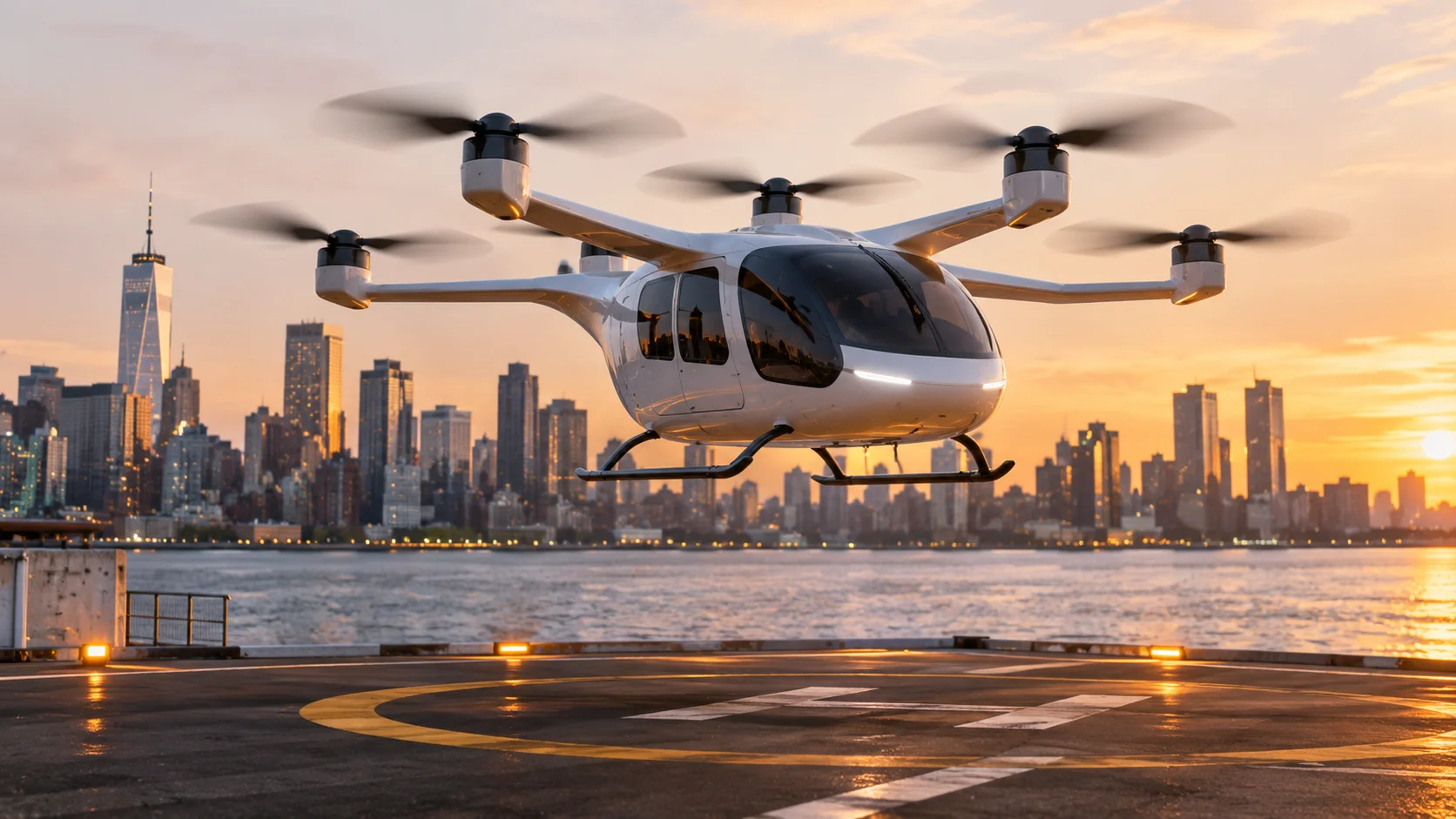
In late April, an electric aircraft registered N545JX lifted off from John F. Kennedy International Airport and set down at the Downtown Skyport and the heliports on West 30th and East 34th Streets. Joby Aviation, which flew it, pitched the campaign around a single number: a drive to JFK that can run 60 to 120 minutes, compressed into a seven-minute flight.
Seven months later, the first seat a New Yorker could buy on that kind of aircraft has moved further out. In its third-quarter shareholder letter on Wednesday, Nov. 4, Joby said that carrying passengers under the federal pilot program "will require companies to be in substantial TIA testing," the final phase of FAA type certification, with FAA pilot training and company flight testing of the relevant aircraft expected in the first half of next year. AVweb reported on Thursday (Nov. 12) that both Joby and its rival Archer Aviation are now targeting 2027 for initial U.S. passenger operations.
For travelers, the short answer is that no one in the United States will ride an electric air taxi as a passenger in 2026, and the earliest flights next year are expected to carry non-paying passengers under a federal test program rather than ticketed customers. Routine commercial service still depends on full FAA type certification, which neither company has received.
What the Pilot Program Promised
The Department of Transportation and the FAA named eight projects to the eVTOL Integration Pilot Program on March 9, and the FAA's announcement said the public should begin seeing operations by summer 2026. The Port Authority of New York and New Jersey led one of them, partnered with Archer, BETA Technologies, Electra and Joby, covering 12 operational concepts that include eVTOL passenger operations at the Manhattan heliport.
The program was designed to let selected aircraft fly real missions before certification is complete, giving regulators data on noise, airspace integration and ground infrastructure. Transportation Secretary Sean P. Duffy said that "the future of aviation is here," while FAA Deputy Administrator Chris Rocheleau framed it in more measured terms, saying the partnerships "will help us better understand how to safely and efficiently integrate these aircraft."
The other seven projects are led by Texas, Utah, Pennsylvania, Louisiana, Florida, North Carolina and the City of Albuquerque, and their mission sets range from urban air taxi routes to cargo, emergency medical response and autonomous flight. New York's selection put the country's densest airspace on the list from the start.
That airspace is the hardest test any of the eight projects faces. Three major commercial airports sit within a short drive of Midtown, helicopter tour and commuter traffic already crowds the corridors over the Hudson and East Rivers, and the heliports that would serve air taxis are wedged between highways and waterfront towers. Flying a new aircraft type through that environment, even with a pilot alone on board, gives the FAA the kind of operational data a quiet test range in the desert cannot.
What Flew, and Where
Pilot-only flying did arrive this year. Joby's April campaign was staged with the Port Authority, and Port Authority Executive Director Kathryn Garcia called the flights "one data point in a larger body of work," a phrase that turned out to describe the year well. Port Authority Chairman Kevin O'Toole said the flights advanced the agency's work "to determine how next-generation aviation technology can serve the people" of the region.
Elsewhere, the company's third-quarter shareholder letter describes missions between Alliance Airport in Fort Worth and DFW International Airport, a vertical takeoff from Albert Whitted Airport in downtown St. Petersburg that crossed the bay to Tampa International, and a landing at a new vertiport near Terminal C at Orlando International. The same letter says Joby completed "a series of significant 'for credit' tests with the FAA," the certification flights that count toward approval.
Dubai, long described as the likely first commercial market, has slipped as well. The letter says Joby continues "to plan for the beginning of operational flight testing there later this year, with a pilot on board," which places paying passengers in the emirate beyond 2026 too.
Why the Timeline Moved
The constraint is the order of operations at the FAA. Type certification for a new category of aircraft runs in stages, and Type Inspection Authorization, or TIA, is the phase in which FAA pilots fly the conforming aircraft themselves to verify that it meets the certification basis. According to AVweb's report, Joby Chief Policy Officer Greg Bowles said commercial flights under the pilot program "will be tied to substantial TIA flight testing," and that testing follows the FAA pilot training scheduled for the first half of 2027.
Archer faces its own sequence. AVweb reported that its Midnight aircraft received an FAA Market Survey Special Airworthiness Certificate for piloted runway demonstrations in Los Angeles, and that Archer must still complete a piloted transition from vertical to wingborne flight before vertical operations can be approved. Archer chief executive Adam Goldstein offered a target of his own: "In 2027, I plan to be Archer's first passenger in Midnight."
For travelers, the distinction between the program's phases matters more than the headlines suggest. Joby's letter describes "a path under the eIPP to progress from pilot-only flights to flights carrying non-paying passengers," which means the first people aboard in 2027 will be riding as part of a federal test rather than buying a ticket through an app. Paid service at scale, with published fares and a schedule, waits on the type certificate.
None of this is unusual for aviation. Certification timelines for new aircraft types, from new engines to entire airframes, have slipped repeatedly across the industry, as anyone following Qantas and its Project Sunrise A350 already knows. What makes the eVTOL delay notable is how close the public-facing demonstrations came to looking like a product.
What New York Flyers Can Book Today
The airport transfer that air taxis aim to replace already exists in a different form. Joby acquired Blade's passenger business in 2025, and its shareholder letter reports that passenger numbers on its New York airport service rose 61 percent year over year in the quarter, with the number of new airport passengers more than doubling. Those flights run on conventional helicopters and seaplanes, which are louder and costlier to operate than the electric aircraft meant to succeed them.
That demand is the case Joby and Archer are building toward. A traveler paying for a helicopter hop from Manhattan to JFK is the obvious first customer for an electric aircraft on the same route, and the heliports Joby used in April are the same ones Blade already flies from. The Manhattan to JFK corridor has the ingredients regulators and operators want: short distance, punishing ground traffic and a customer base already willing to pay to skip it.
What to Watch in 2027
Three markers will tell travelers how close the service is. The first is the start of TIA flight testing with FAA pilots, which both companies tie directly to passenger operations. The second is the first pilot-program flight in New York carrying a non-paying passenger, the step Joby describes as the path from pilot-only flying under the program. The third is a type certificate, the approval that separates a demonstration from a timetable.
Holiday travelers this year will still reach JFK by car, train or helicopter. The aircraft that flew into Manhattan in April have logged their certification credits, the FAA pilots are scheduled for training, and the first public seats, by both companies' own accounts, sit somewhere in 2027.