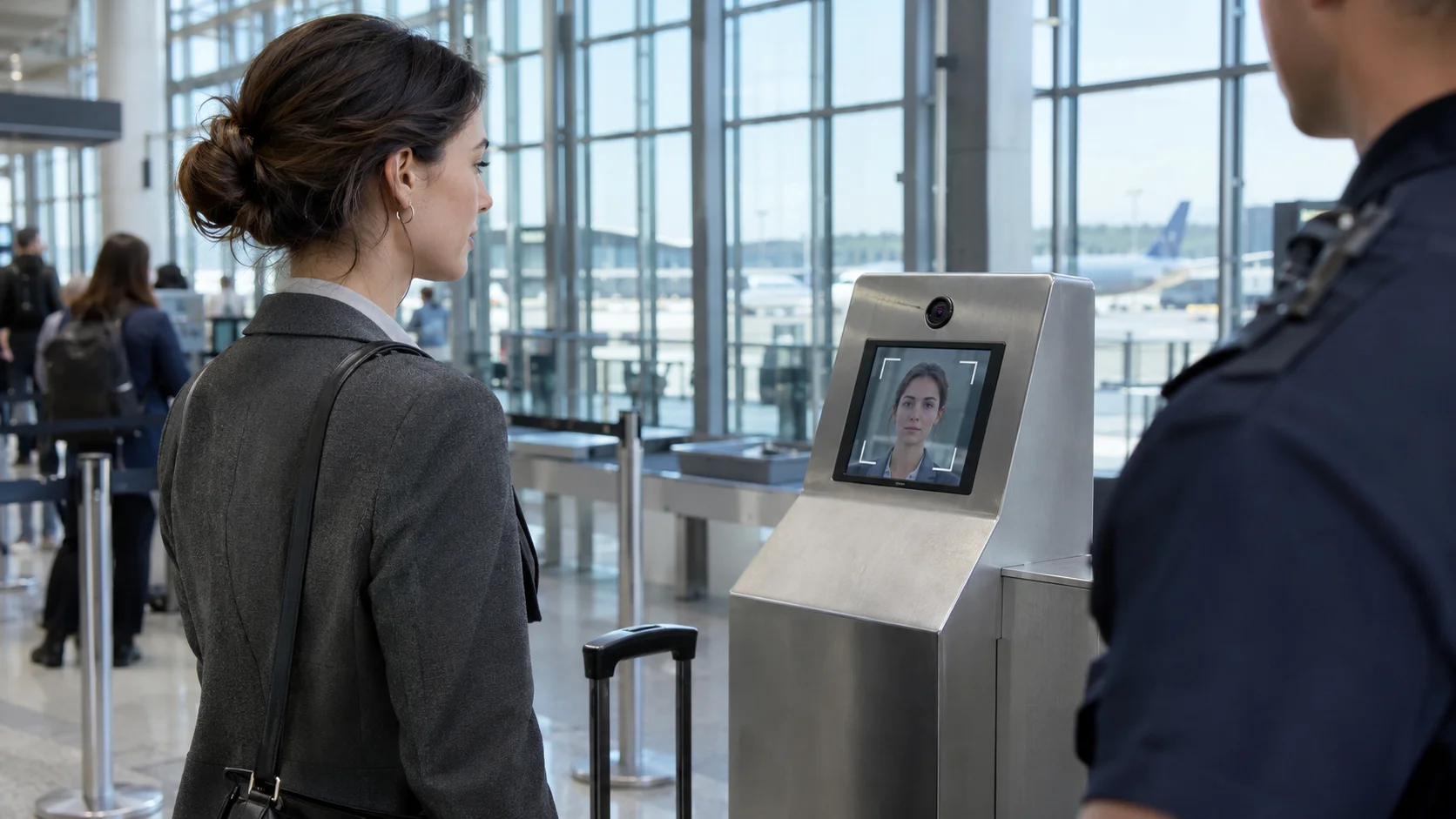
At a growing number of American checkpoints, the officer at the podium no longer studies your face against the photo on your license. A camera does it. At more than 60 airports in Delta's network, a PreCheck traveler with the right enrollment can walk through the checkpoint and onto the jet bridge without producing an ID or a boarding pass at all, and on international trips a federal rule that took effect last December now lets customs photograph every non-citizen entering or leaving the country.
Thanksgiving week is when most occasional flyers meet this machinery for the first time each year. The holiday falls on November 26, 11 days from now, and the busiest travel days of the season will send millions of people past cameras that did not exist at their home airport a few years ago, many of them unsure what the image is used for or whether they are required to sit for it.
For U.S. citizens, facial comparison at TSA checkpoints and at customs is optional, and travelers who decline can ask for a manual ID check instead. TSA PreCheck Touchless ID is an opt-in program run through participating airlines, and Customs and Border Protection says it discards photos of U.S. citizens within 12 hours, while non-citizens are subject to mandatory biometric collection on entry and exit under a rule that took effect December 26, 2025.
Travelers tend to lump everything into a single idea of airport facial recognition, but three distinct programs are at work, and the rules differ for each. The first is TSA's identity check at the standard lane, where a camera mounted on the credential reader compares a live image with the photo on the ID you hand over, a one-to-one comparison in which the machine asks only whether the person standing there matches the document in the slot.
The second is TSA PreCheck Touchless ID, which goes further. Travelers who opt in through their airline let TSA compare their live image against a photo already on file from their passport, so no physical document changes hands at the checkpoint, and at some airports the same image clears bag drop and boarding. The third is Customs and Border Protection's biometric entry and exit program, which matches international travelers against gallery photos built from passport and visa records for a flight's manifest.
Our spring survey of how AI and biometrics are reshaping the airport covered the global picture, from Singapore to Dubai. The American system is more fragmented, and the differences decide where a traveler's image goes and who keeps it.
Delta, which helped launch the program, said in an October update that Touchless ID is live at more than 60 airports, including all of its hubs. Enrollment requires a SkyMiles membership, an active TSA PreCheck membership with a Known Traveler Number stored in the profile, and a valid passport. American Airlines announced in April that the program covers 60 U.S. airports in its network, including Charlotte, Chicago O'Hare, Dallas-Fort Worth, Los Angeles, Miami, JFK, LaGuardia, Philadelphia, Phoenix and Washington Reagan, and the carrier said TSA manages all of the biometric data.
Alaska Airlines brought the program to Seattle, Los Angeles and Portland in the summer of 2025, and its announcement included a line that applies across all three carriers: guests may opt out at any time. Earlier Delta material went further on data handling, stating that the airline does not save or store any biometric data itself.
Airport counts reported by airlines describe each carrier's own network, so a figure of 60 for Delta and 60 for American does not add up to 120 distinct airports, and a passenger's eligibility depends on both the airline and the specific checkpoint. TSA announcements during 2026 have added airports including Boston, Miami, Cleveland, Albuquerque and Oklahoma City to the list, and the agency's own Touchless ID page remains the place to confirm a departure airport before relying on it.
The larger shift happened at the international border. A final rule from the Department of Homeland Security, published in the Federal Register on October 27, 2025, took effect December 26, 2025 and authorizes CBP to collect facial images from non-citizens on entry and departure at all ports. It removed an earlier limit that confined the departure program to 15 air or sea ports, and CBP estimates full implementation at commercial airports and seaports within three to five years.
For U.S. citizens, the rule keeps participation voluntary. Citizens may request an alternative inspection, typically a manual passport check by an officer, and the rule states that any photos of U.S. citizens will be discarded within 12 hours. CBP cites facial comparison matching at a rate greater than 98 percent and sets a performance requirement that the technology correctly match at least 97 percent of in-scope travelers.
Those percentages sound high until they meet holiday volume. A 2 percent miss rate across a widebody's worth of passengers still sends several travelers to a secondary check, which is one practical reason to build extra connection time into any international itinerary booked off the fare and capacity picture in our holiday booking guide.
The right to decline is where travelers and lawmakers have pushed hardest. A bipartisan Senate bill, the Traveler Privacy Protection Act of 2025, would require TSA to give every passenger the option of identity verification without facial recognition, writing into law what is now agency practice. Its sponsors framed the stakes bluntly when they introduced it in May 2025.
"The TSA subjects countless law-abiding Americans to excessive facial recognition screenings as they travel," said Sen. John Kennedy of Louisiana.
Sen. Jeff Merkley of Oregon, the bill's lead sponsor, put it more starkly: "Folks don't want a national surveillance state." By Merkley's account, TSA has been planning to expand the technology to more than 430 airports, and the bill has yet to clear the Senate Commerce Committee, where airlines have lobbied against it.
Oversight has trailed deployment. The Government Accountability Office found in 2020 that CBP had not consistently provided complete information in its privacy notices, that its signage gave limited information on how to opt out, and that as of May 2020 it had audited only one of more than 20 airline partners handling traveler images. GAO judged it too early then to assess TSA's compliance with privacy principles, and the agency's checkpoint program has grown considerably since.
The practical rules for Thanksgiving week are simple. Domestic flyers need a REAL ID-compliant license or another accepted document such as a passport, and travelers who arrive without one now face TSA ConfirmID, an alternative identity check that began on February 1, 2026 and carries a $45 fee along with extra time at the checkpoint.
Anyone who prefers not to be photographed at the standard lane can tell the officer before stepping up to the camera and ask for a manual ID check. Travelers enrolled in Touchless ID can switch the feature off in their airline profile or simply use a regular PreCheck lane and present a physical ID, and returning international travelers who are U.S. citizens can ask the CBP officer for a manual passport inspection instead of the camera.
Peak holiday hours are the worst moment to weigh these choices for the first time, so settle them before reaching the front of the line. The camera is now the default at many checkpoints, and the manual check is still there for anyone who asks the officer for it.