The airport lounge was supposed to solve a simple problem: the terminal was crowded, noisy and expensive, so the traveler with status, a premium ticket or the right credit card could step through a door and leave that friction behind. In 2026, the door is still there. Increasingly, the crowd is waiting on the other side.
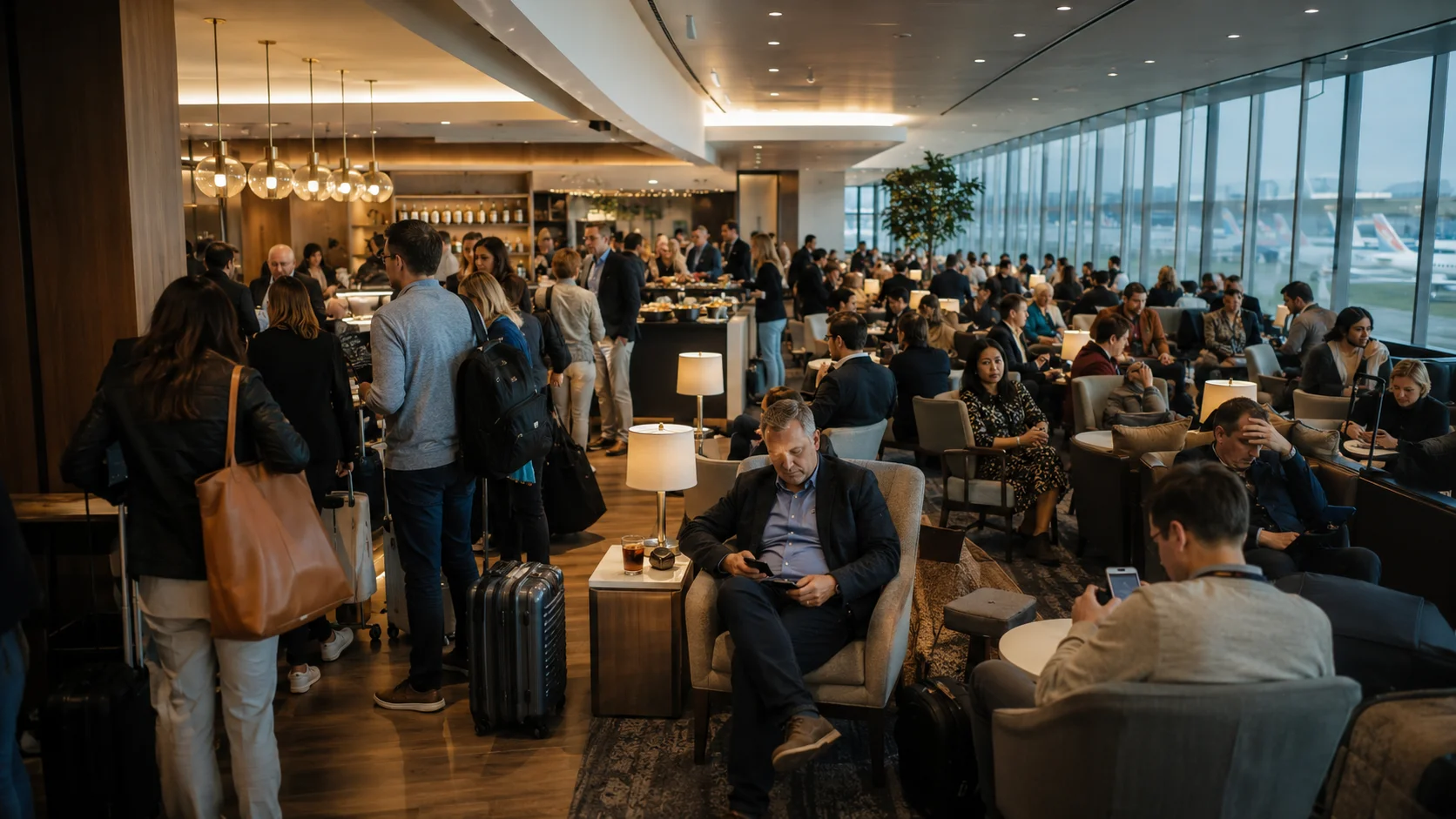
The clearest evidence arrived this month. The 2026 J.D. Power U.S. Airport Lounge Satisfaction Study, based on responses from 2,991 travelers, found that 46% of guests say the lounge they use most often is usually moderately or severely crowded. The effect is not cosmetic. Satisfaction averaged 833 points among travelers who described their lounge as not crowded at all, then fell to 589 among those who described severe crowding, a 244-point collapse on a 1,000-point scale.
That finding lands differently because the lounge is no longer a side amenity for a narrow band of frequent flyers. J.D. Power found that 45% of lounge customers use the space to escape crowded terminals, while 39% say high airport food and beverage prices push them inside. Andrea Stokes, the firm's hospitality practice lead, called the lounge "an oasis for travelers," a description that captures exactly why density matters so much. In other words, the industry built a refuge from the terminal, then made the refuge attractive enough to reproduce the very problem it was designed to solve.
SA Alliance Air SA Alliance Air contended in July that the airport lounge had been oversold as card issuers widened access and then began tightening the rules. The new data does more than confirm the crowding. It shows that the lounge has become its own airport economy, one powerful enough to shape card portfolios, airline loyalty strategy, terminal construction and the price of sitting somewhere quieter before boarding.
The crowding problem is now measurable
For years, lounge overcrowding was discussed mostly through anecdotes: lines outside Centurion Lounges, waitlists at Capital One, a packed Sky Club at the afternoon bank, or a Priority Pass member turned away because a contract lounge had reached capacity. J.D. Power has now attached a customer-experience cost to the problem. A 244-point satisfaction gap between an empty-feeling lounge and a severely crowded one is not a minor service blemish. It is evidence that density can overwhelm nearly every other premium feature in the room.
The contradiction is especially sharp because travelers are not primarily entering lounges for theatrical luxury. Complimentary food and beverage ranked as the top benefit in the 2026 study, followed by comfortable seating. More than half of respondents, 52%, said lounge food and beverage was better than expected, and another 44% said it met expectations. Staff scored well on welcome, with 77% of guests saying employees were welcoming. The fundamentals are often working. The room itself is the constraint.
That explains why a beautiful lounge can still feel disappointing at 5:30 p.m. A marble bar, chef-designed buffet and rainfall shower do not mean much if every power outlet is occupied and a traveler has to circle the room with a carry-on looking for one open chair. Premium hospitality depends partly on subtraction. Space, quiet and the absence of competition for basic comforts are part of the product even when they never appear on the amenity list.
Credit card companies are now running some of America's favorite lounges
The 2026 rankings also reveal how far the business has moved away from the old airline-club model. American Express Centurion Lounges and Capital One Lounges tied for the highest customer satisfaction score at 771. Chase Sapphire Lounges ranked third at 764. Delta Sky Club, which now includes Delta One Lounges in J.D. Power's network scoring, followed at 763. The first three positions belonged to financial-services brands before an airline appeared.
That is not a trivia point. It is a map of who now controls a meaningful part of the premium airport experience. The premium credit card is no longer merely a payment method that happens to unlock an airline lounge. Amex, Capital One and Chase have built branded hospitality networks where the card itself becomes the travel product. The lounge is where an annual fee turns into something physical: a plate, a drink, a shower, a quiet seat and a sense that the traveler bought distance from the terminal.
The issuers are still expanding. American Express said in April that its Centurion Lounge network had reached 32 locations and announced a future Boston lounge, a second Sidecar concept in Charlotte and an expanded Dallas Fort Worth space. Chase says Los Angeles and Dallas Fort Worth lounges are coming in 2026. These are not the moves of companies preparing to abandon airport hospitality. They are the moves of companies trying to add enough capacity to protect one of the most visible benefits attached to expensive cards.
The access rules are becoming a form of crowd control
More square footage is only one solution, and it is the slow one. The faster response has been to narrow who gets through the door, how often they can enter and how many people they can bring with them.
Capital One changed the math on February 1. Venture X cardholders no longer receive automatic complimentary guest access at Capital One Lounges and Landings. Adult guests now cost $45 per visit, younger guests cost $25, and additional cardholders who want lounge access carry a $125 annual fee. Complimentary guests can return for cardholders who reach $75,000 in annual account spending. The policy preserves the benefit while making frequent group access more expensive.
American Express tightened its Centurion Lounge rules again on July 8. Guests must now be traveling on the same flight as the cardmember, and complimentary guest privileges remain tied to $75,000 in eligible annual spending for Platinum accounts. Delta uses a similar spend threshold for unlimited Sky Club access. U.S. Amex Platinum cardmembers receive 10 Sky Club visits per Medallion Year, while Delta Reserve cardmembers receive 15, with unlimited access available after $75,000 in eligible annual purchases.
The common denominator is not subtle. The industry is using spending thresholds, guest fees and visit caps as capacity-management tools. The lounge perk is still being sold broadly enough to attract customers, but its most convenient version is increasingly reserved for travelers who spend more.
American Airlines just put a new price on belonging
The airline side is moving in the same direction. On August 23, American Airlines introduced a new Admirals Club membership structure. A standard Admirals Club membership now costs $1,400 for a general AAdvantage member, with lower pricing for higher elite tiers. American also introduced a $750 single membership for individual access and discontinued new household memberships.
American says the higher rates support "expanded food and beverage offerings, refreshed lounge designs, improved service" and new concepts such as Provisions by Admirals Club. The company also warns that one-day passes can be limited or unavailable when lounges are crowded. That caveat is as important as the price. A lounge operator can sell access, but it cannot sell a seat that no longer exists.
The change also fits a broader pattern at American. SA Alliance Air recently examined how the carrier is moving some of its most valuable premium benefits toward paid access. Lounge pricing follows the same commercial logic. The premium experience is not disappearing. It is being repriced, segmented and protected from the volume created when too many customers receive the same promise.
The real luxury product is no longer food. It is space.
Airlines appear to understand that distinction at the highest end of the market. Delta has built Delta One Lounges at JFK, Los Angeles, Boston and Seattle that are available primarily to eligible Delta One and partner premium-cabin travelers rather than the broad population of premium credit card users. At Los Angeles, Delta opened the first phase of a second Delta One Lounge in June and says its total lounge footprint at LAX will reach 60,000 square feet with more than 1,000 seats when its planned work is complete in 2028.
That investment suggests the lounge business is not suffering from weak demand. It is suffering from demand strong enough to force segmentation. The crowded general premium lounge and the tightly gated business-class lounge are becoming two different products even when they sit in the same terminal and serve travelers heading to the same aircraft.
This is where the old definition of exclusivity breaks down. A lounge does not become premium because the furniture is expensive or because a bartender can make an espresso martini. It becomes premium when the traveler can reliably use what was promised. If access requires a waitlist, if the buffet line resembles the concourse food court, or if every quiet corner has become a conference call booth, the brand may still be premium on paper while the experience has become ordinary.
The airport lounge is becoming a loyalty battleground
There is a reason banks and airlines are willing to spend on this problem. Lounges affect behavior beyond the hour before departure. J.D. Power's inaugural 2025 lounge benchmark found that 82% of lounge customers said lounge access influenced their airline choice, while 47% said it influenced route selection. The lounge can pull a customer toward a card, a carrier, a connection airport and, eventually, a larger share of annual travel spending.
That makes crowding more than an operations problem. It is a loyalty problem. The credit card issuer that promises a sanctuary and repeatedly delivers a waitlist risks weakening the emotional value of a card whose annual fee may run hundreds of dollars. The airline that charges four figures for club membership has to offer something meaningfully better than a terminal restaurant, especially when airport public spaces themselves are improving.
The industry now has three levers and is pulling all of them at once: build more lounges, charge more for access and reserve the best spaces for the highest-value customers. That does not mean the era of lounge access is ending. It means the era of treating all lounge access as roughly equivalent is ending.
For travelers, the practical question is no longer whether a card includes lounges. It is whether the lounge network matches the airports, companions and travel patterns they actually use, and whether the access rules still make sense after guest fees and visit limits are counted. The logo on the metal card matters less than the probability that there will be a chair waiting when the traveler arrives.
The lounge was invented as an escape from airport congestion. In 2026, its future depends on whether the industry can keep the escape from becoming just another line.